WNBA’s Historic 2026 CBA: How Record Salaries and Player Benefits Are Redefining Women’s Sports

Massive Pay Increase: WNBA minimum salaries jump from ~$66K to $270K+, with supermax deals reaching $2.4M by 2032.
Historic Agreement: The 2026 CBA represents one of the largest salary jumps ever negotiated by a labor union.
Beyond Pay: New benefits include full chartered travel, family support policies, and protections for pregnant players.
At Parity we’re all about getting athletes paid. Today, we’re talking about athletes who are finally getting an overdue paycheck: women’s professional basketball players.
There has been a lot of chatter about how the WNBA doesn’t make a profit and doubters wondering where the money would even come from to pay the players more. There’s been a lot of “wait your turn” noise and somehow still a lot of “no one watches women’s sports” nonsense. However, with the collective bargaining agreement (CBA) expiring at the end of the 2025 season, all of that chatter came to a head. The players promised they were willing to strike to see a transformational new CBA signed, the league pushed back. As the weeks of negotiations stretched into months, time was running out for the two sides of the table to see eye to eye.
But on March 24th, the WNBPA and the WNBA ratified a shiny new CBA just in time to save the 2026 season, and so, so much more. This CBA represents a score of important changes in how the WNBA operates, but the part that has everyone buzzing is the money. As far as we are aware, the salary increase the players are about to receive represents the biggest jump in salary negotiated by any union anywhere. So this CBA is not just changing how women’s basketball players are compensated, or even female athletes: this is changing how women everywhere are valued and respected as professionals.
There’s someone we want you to meet.
Claudia Goldin became the first ever solo woman to win the Nobel Prize in economics in 2023. Her work focuses largely on labor and specifically on the persistent gender gap that exists between men and women. After winning her Nobel, she was flooded with requests. Legend has it that she accepted just three, and one of the emails that went answered was to the WNBPA. Something we love about Claudia, and about numbers, is they spit out nothing but facts.
People love to talk about numbers when they talk about the gender pay gap in sports. “It’s just that women don’t bring in the numbers!” “No one watches them, why should they be paid?” “It’s just math.”
So when Claudia started working with the WNBPA, she went straight to the math. What are the numbers saying? She went to viewership, and she went to ticket sales. People loooove to talk about eyeballs these days, and how views means money. So Claudia said, sure, let’s talk about them. She found, after adjusting for game and season length disparities, that the WNBA attracts approximately one-third of the eyeballs per player as the NBA does, and about one-fourth of butts in seats. However, the WNBA players were only being paid 1/80th of what the NBA players were making.
Why does this comparison matter? Well, over half of the WNBA is owned by the NBA. This means that a lot of the money to pay players in the NBA and WNBA is coming from the same pockets. And it means that the WNBA players should be making between 25 and 30% of what their male counterparts were making. (Remember, they were making just 1/80th, or 1.25%.) This is what WNBA players have been saying for years. They don’t want the same money as NBA players, they just want equal treatment.
Claudia helped show how vastly underpaid these players really were. And it wasn’t from a lack of funds. It was a choice.
The biggest contributor to the gender pay gap (at large, which, by the way, is getting bigger, not smaller year over year) is not that women get paid less money for doing the same work. The biggest contributor to the pay gap is that the jobs that women do are valued disparately. The sectors of work that disproportionately hire women (think teaching) pay less than sectors of work that disproportionately hire men (think plumbers). As long as we consider the jobs done by men as more valuable than the jobs done by women, the pay gap will persist.
NBA executives have been saying that WNBA teams are “losing them money” and at the same time paying $250 million to bring a WNBA franchise to their city. NBA owners are fighting over these teams, but have been paying the players pennies. Again, not because of lack of funds, but rather because of the same prejudices that pay teachers pennies. Because so many people continue to think of women’s sports leagues as less than compared to men’s sports leagues. Because they think that the work done there is less valuable, and therefore less worthy of compensation.
We have to imagine that if a woman were to play in the NBA, she would be paid accordingly. If a woman played in the NHL, she would not be given a special “woman’s contract” and take home a fraction of her teammates’ paychecks. Now that would be discrimination. But to buy up women’s teams and then pay those employees less than they’re worth? Well, it’s a women’s team after all. It’s nothing personal, it’s just the numbers.
So, just because we love looking at them, let’s look at the numbers.
In 2025, the minimum salary for WNBA players was $66,079. That number is now between $270,000 and 300,000 depending on years of service in the league. By the end of the 7 year CBA term that number will be between $340K-$380K. These numbers not only represent dollars in pockets, but represent financial and personal freedom. Many players now will not need to balance a second or third job, or travel overseas during the offseason. Players can now afford to make investments for themselves and their families, building generational wealth for the first time. On the other end, the supermax salary in 2025 was $249,244, which will be up to $1.4 million in 2026 and $2.4 million by the end of 2032. At that time, the average WNBA salary will be above $1 million. Kelsey Mitchell of the Indiana Fever was one of the first players to sign the $1.4 million supermax contract, the franchise rewarding her for a career’s worth of service. The 2026 season will be Mitchell’s 9th in the WNBA (and with Indiana), and she has been one of the league’s highest paid players through the last few seasons. But her new contract for this season alone outstrips what she made in the last 8 seasons combined.
It’s not the end of the negotiations. In 7 years, we’ll go to battle again for these women to get what they deserve. And today and every day we’ll fight for female athletes to get compensated. But for now, there’s so much to celebrate, and it’s not just about the money (I mean, it is a lot about the money). It’s also about the parts of the CBA that make it a CBA for a women’s league. Female athletes need things most male athletes just don’t have to think about, and we’re here to celebrate the following structural changes that are about to raise the standard forever.
- 1.Chartered Travel
The lack of chartered travel has been a huge sticking point within the WNBA over the past number of seasons, especially as players have begun to attract (more) international fame. The safety of players has been at risk, nevermind suboptimal travel conditions putting teams and players at a disadvantage with tight turnarounds and late nights. There have been starts and stops with some teams getting charters and some not, playoffs chartered but regular season not. The new CBA guarantees chartered travel for every team, all season long.
2. Traveling with children
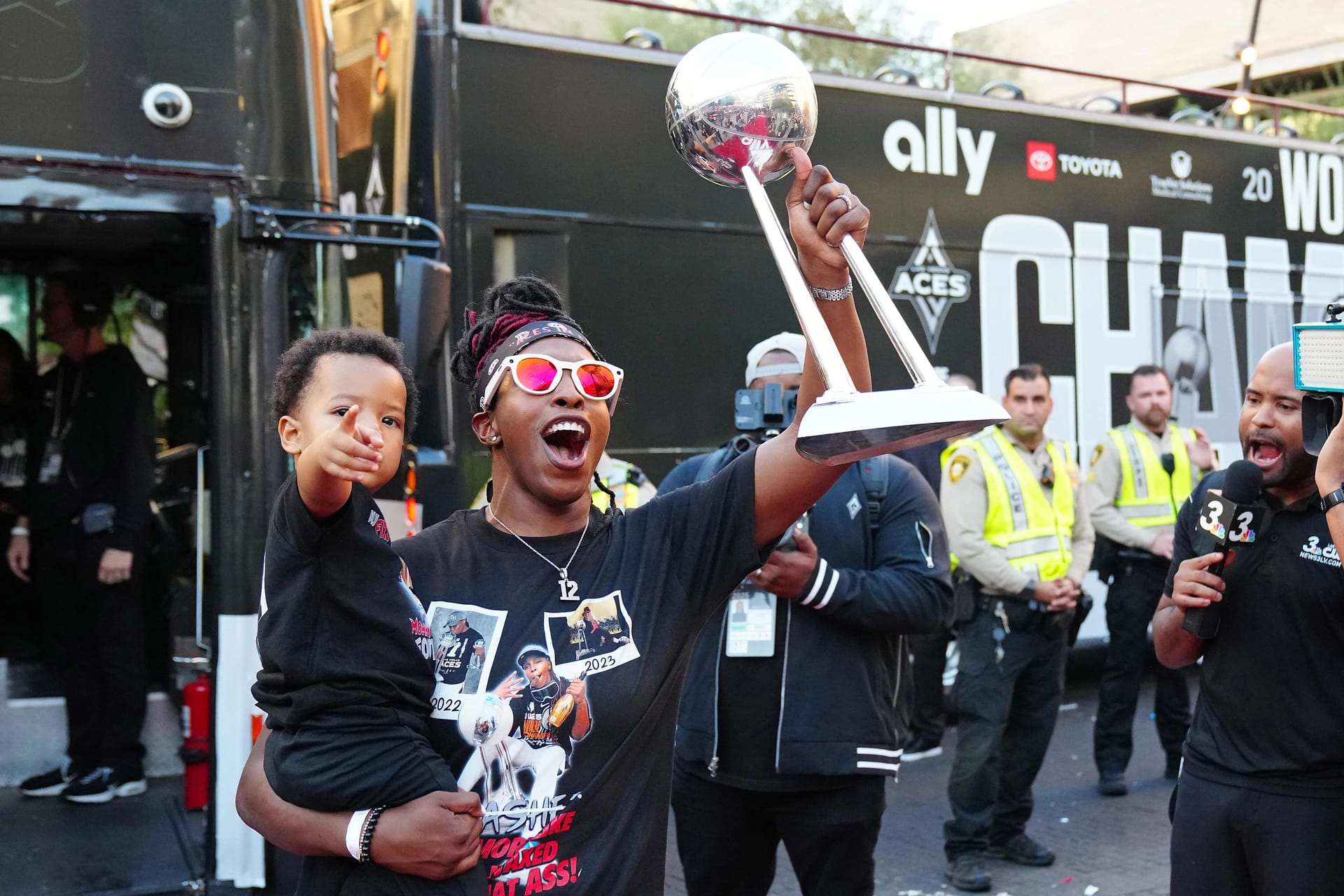
There are an increasing number of players in the WNBA who are moms, and that’s a job that doesn’t stop when the season starts. Teams are now required to allow dependent children under the age of 13 to travel with the team and pay for their accommodation. It’s not only the right thing to do, to support mothers with young kids, but also helps raise a new generation steeped in female excellence. As Vegas point guard Chelsea Gray wrote in her “A Letter to My Son,” “I just think it’s pretty damn cool for you to be around so many other amazing women athletes and their kids.”
3. Pregnancy
The WNBA already had a progressive maternity leave policy, but this CBA goes one step further towards protecting pregnant players. Teams are now not allowed to trade pregnant players without their express consent. Many suspect that this update was made in response to the Dearica Hamby/Las Vegas Aces conflict over her pregnancy last season, but whatever the reason, this update was much needed. To be pregnant and traded without your consent or knowledge is to have to uproot your life during a time that is already so full of change. Now players do not need to worry about their job when worrying about one million different pregnancy/baby related things!
4. Recognition payments for retired players
This might not feel like a female-specific issue, but I promise you, it is. Female athletes do not retire with the amount of money in their pockets that male athletes retire with. And too often, they never see a dime of the money they worked so hard for future players to receive. Retired WNBA players will be given a one time payment of $30,000 for 5-7 years of service, $50,000 for 8-11 years and $100,000 for 12 plus years of service to the league. For the majority of WNBA vets, this is life-changing money.
5. Family Planning
The new CBA promises expanded family planning benefits, but which benefits will be expanded and how have not been announced as of writing. Whatever they turn out to be, this is such a crucial part of support for any women’s sports league. The best time (biologically) to start a family often coincides with a female athlete’s peak competition years, and figuring out how to balance both can be stressful and expensive, and stressful because it’s expensive. Having supportive policies in place helps protect players during this time and enables them to be their best selves on and off the court.
We cannot wait for the WNBA season to start. With two brand new expansion teams and all the biggest stars back on the court, it promises to be a special one. Something that has always impressed me is how hard these women, and the women who have come before them, have always balled out no matter how little they were being paid. There has never been a season that wasn’t exciting, never a championship that wasn’t worth watching. Female athletes continue to relentlessly prove that women’s sports are thrilling, competitive and worthy of eyeballs and investment. We’re so proud of the WNBPA for this historic agreement and can’t wait to see where it takes the WNBA, and all other women’s leagues to come.

Infuse your women's sports strategy with powerful insights from pro athletes and fans.

